
Many of us don't like the government interfering in our lives, but we often expect the government to protect us. Police, firemen, etc. are government employees. We expect the Food and Drug Administration (FDA) to keep our food safe and tell us which medications are safe and effective. We expect the Environmental Protection Agency (EPA)to keep us safe from toxic chemicals in our food, water and environment.
I've written in recent blogs about the effect of heavy metals on the body, and how heavy metals and chemicals are ubiquitous in our food, water and environment. The following statement by Lisa Jackson, Administrator of the EPA, shows us how ineffective the EPA really is. She states that the EPA has the authority to control only around 200 chemicals out of the 80,000 currently being manufactured.
We really have no idea how these chemicals are affecting our health. With dramatic increases in autoimmune diseases, mental illness, autism, ADHD, etc., could there be a correlation? Wouldn't it be good to find out? Again, I am a proponent of less government intrusion, but as I've studied this, the businesses really have no concern whether these chemicals are affecting our health or not. They are concerned with the financial bottom line.
Please read the following and form your own conclusions. Comments are welcome.
Legislative Hearing on the Toxic Substances Control Act (TSCA)CONTACT:
EPA Press Office
press@epa.gov
202-564-4355
FOR IMMEDIATE RELEASE
December 2, 2009
Statement of Lisa P. Jackson
Administrator, U.S. Environmental Protection Agency
Legislative Hearing on the Toxic Substances Control Act (TSCA)
Senate Committee on Environment and Public Works
December 2, 2009
WASHINGTON – Chairman Lautenberg, Chairman Boxer, Ranking Member Inhofe and other members of the committee, thank you for the opportunity to speak about how we can improve our framework for assessing and managing chemical risks.
Understandably, the public is turning to government for assurance that chemicals that are ubiquitous in our economy, our environment and our bodies have been assessed using the best available science, and that unacceptable risks have been eliminated.
But, under existing law, we cannot give that assurance. Restoring confidence in our chemical management system is a top priority for me, and a top environmental priority for the Obama Administration.
EPA is the agency tasked with ensuring that the chemicals used in the American economy are safe. But, Mr. Chairman, the current law that gives EPA that authority is outdated, and does not provide the tools to adequately protect human health and the environment as the American people expect, demand and deserve.
Chairman Lautenberg, I commend you for your long standing leadership on this issue and look forward to working with you, Chairman Boxer and other Members of this committee as you consider ways to improve the safety of chemicals.
The Toxic Substances Control Act (TSCA) was signed into law in 1976 and was intended to provide protection of health and the environment against risks posed by chemicals in commerce. However, when TSCA was enacted, it authorized manufacture and use, without any evaluation, of all chemicals that were produced for commercial purposes in 1976 or earlier years. Thus, manufacturers of these “grandfathered” chemicals weren’t required to develop and produce the data on toxicity and exposure that are needed to properly and fully assess potential risks. Further compounding this problem, the statute never provided adequate authority for EPA to reevaluate existing chemicals as new concerns arose or as new scientific information became available.
TSCA does provide some authority to EPA to mandate industry to conduct testing, but even in these cases it has taken years to obtain data and information. As a result, there are large, troubling gaps in the available data and state of knowledge on many widely used chemicals in commerce.
TSCA also doesn’t place any legal obligation on producers to conduct testing on new chemicals being introduced into commerce. They are required only to supply existing data to EPA and are not required to provide all the data necessary to fully assess a chemical’s risks.
In the rare cases where EPA has adequate data on a chemical, and wants to protect the public against well-known, unreasonable risks to human health and the environment, there are too many legal hurdles to take quick and effective regulatory action
For example, in 1989, after years of study, EPA issued a rule phasing out most uses of asbestos – a chemical whose health effects had been exhaustively studied and demonstrated to cause lung cancer, mesothelioma and asbestosis in humans. Yet, a federal court overturned the rule because EPA failed to clear the many hurdles imposed under TSCA before existing chemical risks can be controlled
Due to these legal and procedural hurdles in the law over the last 30 years, EPA has only been able to require testing on around 200 chemicals produced and used in the United States, and it has only issued regulations to control five existing chemicals determined to present an unreasonable risk under Section 6 of TSCA. Five from a total universe of more than 80,000 existing chemicals listed on the TSCA Inventory. Though many of these chemicals likely pose little or no risk, the story is clear---we’ve only been able to effectively regulate a handful of chemicals and we know very little about the rest.
TSCA must be updated and strengthened.
Earlier this fall, I announced the Obama Administration’s legislative principles for how this law should be revised and modernized. Let me highlight the Obama Administration’s principles:
First, chemicals should be reviewed against safety standards that are based on sound science and reflect risk-based criteria protective of human health and the environment. Safety standards should be driven solely by scientific evidence of risks. EPA should have the clear authority to establish safety standards that reflect the best available science while recognizing the need to assess and manage risk in the face of uncertainty.
Second, the responsibility for providing adequate health and safety information should rest on industry. Manufacturers must develop and submit the hazard, use, and exposure data demonstrating that new and existing chemicals under review are safe. If industry doesn’t provide the information, EPA should have the necessary tools to quickly and efficiently require testing, or obtain other information from manufacturers that are relevant to determining the safety of chemicals, without the delays and obstacles currently in place, or excessive claims of confidential business information.
Third, EPA should have clear authority to take risk management actions when chemicals do not meet the safety standard, with flexibility to take into account a range of considerations, including children’s health, economic costs, social benefits, and equity concerns. EPA and industry must include special consideration for exposures and effects on groups with higher vulnerabilities – particularly children. For example, children ingest chemicals at a higher ratio to their body weight than adults, and are more susceptible to long-term damage and developmental problems. Our new principles offer them much stronger protections.
Fourth, EPA should have clear authority to set priorities for conducting safety reviews. In all cases, EPA and chemical producers must act on priority chemicals in a timely manner, with firm deadlines to maintain accountability. This will not only assure prompt protection of health and the environment, but provide business with the certainly that it needs for planning and investment.
Fifth, we must encourage innovation in green chemistry, and support research, education, recognition, and other strategies that will lead us down the road to safer and more sustainable chemicals and processes. All of this must happen with transparency and concern for the public’s right to know.
Finally, implementation of the law should be adequately and consistently funded, in order to meet the goal of assuring the safety of chemicals, and to maintain public confidence that EPA is meeting that goal. To that end, manufacturers of chemicals should support the costs of Agency implementation, including the review of information provided by manufacturers.
I know that legislative reform may take time. Consequently, I have directed my Assistant Administrator of Pollution Prevention and Toxic Substances, Steve Owens, to utilize our current authority under TSCA to the fullest extent possible, including Section 6 authority to label, restrict, or ban a chemical, to ensure that we do everything we can to protect the American people and the global environment from dangerous chemicals. While fundamental reform is needed to fully protect against chemical risks, this is a step forward.
Specifically, EPA is currently evaluating an initial set of chemicals based on available hazard, exposure, and use information, for potential action. We will complete and make public “action plans” for the chemicals which will outline the risks that the use of these chemicals may present and what steps we may take to address those concerns. Following this, we aim to complete and make publicly available a group of chemical action plans every four months. EPA intends to engage stakeholders and dialogue with other federal partners, as well as the public, in the discussion about prioritizing chemicals for future risk management action over the coming months through public notices and public meetings.
But let me be clear – this is no substitute for meaningful reform of the underlying law. The need for fundamental TSCA reform has been recognized by industry groups, including the American Chemistry Council, environmental groups, public health groups, several States and cities, and many other groups who have all called on Congress to Act. I too call on Congress to act on this issue and give EPA the tools to adequately protect human health and the environment.
The time has come to bring TSCA into the 21st Century. EPA looks forward to working with this committee on this very important issue.
Until we meet again,
Dr. Judi


 The water crisis in Flint, Michigan, brought to the forefront for a moment the hazards of chemicals, pollutants and industrial dumping to our and our children's health. But Flint isn't the only city in danger from lead poisoning. 5 percent of Flint children tested
positive for elevated lead levels compared to 8.5 percent in
Pennsylvania, 6.7 percent in parts of New York State, and 20 percent in
Detroit. In the U.S. as a whole, more than half a million children between the ages of 1 and 5 still suffer from lead poisoning. And lead is only one of thousands of toxic metals and chemicals we are exposed to.
The water crisis in Flint, Michigan, brought to the forefront for a moment the hazards of chemicals, pollutants and industrial dumping to our and our children's health. But Flint isn't the only city in danger from lead poisoning. 5 percent of Flint children tested
positive for elevated lead levels compared to 8.5 percent in
Pennsylvania, 6.7 percent in parts of New York State, and 20 percent in
Detroit. In the U.S. as a whole, more than half a million children between the ages of 1 and 5 still suffer from lead poisoning. And lead is only one of thousands of toxic metals and chemicals we are exposed to. The entire U.S., in fact the entire world, is in the midst of a toxic crisis. Over 200 toxic chemicals are found in our blood and in breast milk. A 1995 study showed that 287 chemicals were found in the umbilical cord blood of newborns, with the majority of them known carcinogens and neurotoxins. The President’s Cancer Panel even stated, “… To a disturbing extent, babies are born ‘pre-polluted.’”
 In 2014, a
review in The Lancet Neurology noted industrial chemicals that injure the developing brain are among the known causes for rising rates of neurodevelopmental disabilities. This includes autism, attention-deficit hyperactivity disorder, dyslexia and other cognitive impairments.
In 2014, a
review in The Lancet Neurology noted industrial chemicals that injure the developing brain are among the known causes for rising rates of neurodevelopmental disabilities. This includes autism, attention-deficit hyperactivity disorder, dyslexia and other cognitive impairments.
 Environmental
toxins come from many sources: Waste products from industry, mining
and industrial farming enter our air, ground and water supplies. Toxic
cleaning supplies fill our cabinets. Known carcinogens such as
pthalates are put into our skin and hair products. Adjuvants in
immunizations are known neurotoxins and carcinogens. Many food
additives that are determined by the government to be safe for
consumption have never been studied for the effects of long-term
consumption. Fire retardants are in our furniture and clothes. Toxic
chemicals are in our carpets. Even toys are often made from toxic
chemicals.
Environmental
toxins come from many sources: Waste products from industry, mining
and industrial farming enter our air, ground and water supplies. Toxic
cleaning supplies fill our cabinets. Known carcinogens such as
pthalates are put into our skin and hair products. Adjuvants in
immunizations are known neurotoxins and carcinogens. Many food
additives that are determined by the government to be safe for
consumption have never been studied for the effects of long-term
consumption. Fire retardants are in our furniture and clothes. Toxic
chemicals are in our carpets. Even toys are often made from toxic
chemicals.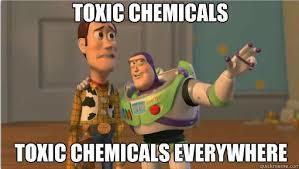


 Posts
Posts


