
This season is supposed to be the worst flu season in ten years. It is true that there is a lot of illness going around this winter, however, most people don't actually have the flu. The "stomach flu" is not actually from the influenza virus; it is caused by other viruses. The influenza virus causes respiratory illness, however, what most people consider the flu may actually be just a bad cold.
Most people who actually get the flu are sick for a week or two and get better. Most people who get colds are sick for a few days to a couple of weeks and get better. However, if the immune system is weakened, colds and the flu can worsen and become bronchitis or even pneumonia. Most of the deaths caused by the influenza virus are caused by pneumonia, because antibiotics cannot kill a virus.
The majority of illnesses in winter are viruses. The flu and colds are from viruses. Even most bronchitis is related to viruses. However, if the immune system is weak, it is easier for a viral infection to become a bacterial infection, and turn into a more serious infection.
If the immune system is strong, it can usually fight off a bacterial infection even without antibiotics. Humanity has survived for millenia without antibiotics, because the immune system works. Antibiotics should be reserved for serious infections that are more prone to overwhelm the immune system. Using antibiotics for minor infections keeps the immune system weak and causes antibiotic resistance, so that when a major infection comes it is harder to find an antibiotic that works.
The flu shot is still controversial. Some people swear it is what keeps them from getting sick. Others say they get sicker when they get the shot. I'm sure it depends on each individual's system whether the vaccine helps them or not. But the truth is, the influenza vaccine has never been proven effective or completely safe. There is mercury in the multidose vials, and aluminum, formaldehyde and other toxic additives in it. If you get the single dose vial, instead of mercury you get 2-Phenoxyethanol, an anti-bacterial agent being used as a replacement for the preservative Thimerosal (mercury). This has it's own level of toxicity. If a person already has a heavy toxic load, known or unknown, the flu shot might worsen the immune system and cause other problems.
If you decide not to get a flu shot, or even if you do, how do you protect yourself from the winter viruses? By reducing your exposure and building your immune system. The following are things you can do to keep yourself healthier during the winter virus season.
Reducing Exposure
We are all aware of these--don't leave the house if you are sick, don't go into crowds, wash hands frequently, don't shake hands, avoid being around sick children and others, etc.
Cochrane Collaboration research shows that washing your hands frequently is THE BEST way to curb the spread of respiratory infections. Dr. Tom Jefferson of Cochrane told the magazine Der Spiegel… "This method can fight against the 200 pathogens that bring about flu symptoms as well as against gastrointestinal viruses and completely unknown germs. One study done in Pakistan has shown that hand-washing can even save children's lives."
But since all of these aren't always possible, it is important to build the immune system, so even if you do get sick it is not a serious illness.
Remember, getting sick is not a bad thing. If your immune system is healthy, getting sick actually builds your immune system so that it is resistant to getting that illness in the future. So if you have a healthy immune system and you get the flu this year, it is better than a vaccine at preventing the flu next year.
Building the Immune System
Vitamin C--the old standby, but that is because it does make a difference. For prevention in children use a 500 mg chewable tablet a day, in adults 1,000 to 2,000 mg per day.
If your child starts to get sick, increase the dose to 500 mg every 2 hours. As an adult use 1,000 mg every 1 to 2 hours. It seems like a lot, but if you study animals, who make their own vitamin C, when they get sick their levels go much higher than this. When you are sick your body can handle more vitamin C than when well. It needs more. If you get diarrhea you can back off, but I haven't seen that happen to those on high doses when they are sick.
If you get the influenza virus and it is hitting you hard, get high dose (40-60 grams) intravenous vitamin C from your local integrative doctor (
www.acamnet.org). This will usually turn the flu around so that you start to get better rather than worse. If your doctor does ozone autohemotherapy and ultraviolet therapy (
www.ozonetherapies.com) that will add to the effectiveness.
Vitamin D--the majority of the US population is low in Vitamin D unless they are supplementing, because of the fear of the sun, sunscreen, covering ourselves up, and the angle of the sun in the more northern latitudes. In my patient population in Utah probably around 90% are lower than optimal, even when they are taking Vitamin D.
Ask your doctor to take your level--it is a simple blood test. In the winter, for full immune protection, we want a level between 60-100. To keep it at that level you may need 5,000 to 10,000 IU per day. Most supplements have around 400 IU. Most people need more than that. There is one study which shows that adequate levels of vitamin D is more effective than the flu shot in preventing flu.
If you do get a virus, double your dose of Vitamin D until you are better. It will lessen the damage done by the virus and support the immune system in fighting it.
Vitamin A and Beta Carotene
Getting 5,000 IU of Vitamin A and 10,000 IU of Beta Carotene a day during the flu season supports your immune system and assists the body in fighting off viruses that you may pick up even before symptoms start.
If you do get a virus, use 50,000 to 100,00 IU of Vitamin A (NOT Beta Carotene--look at the labels) a day for 3 days. This can be very effective in assisting your immune system to get rid of the virus.
Other antioxidants
A good multivitamin/mineral with zinc, selenium, and vitamin E (preferably mixed tocopherols) is also helpful.
Herbs
Various herbs and other plants have been used in many indigenous cultures for centuries to support the immune system. Some of the best:
- Astragalus--100 to 150 mg/day for prevention, 3 times a day if you get sick.
- South African geranium (umckaloabo)--especially with bronchitis, 20 mg/day for prevention, 3 times a day if you get sick
- Diamond Mills Yeast, baker's yeast, medicinal mushrooms (such as maitake) which all contain Beta-glucan, or Beta-glucan supplements themselves. I take Diamond Mills Yeast, 1/3 tsp a day, found at animal feed stores. It is also found in the supplement EpiCor. Maitake Gold beta-glucan is another source.
- Echinacea--beware of the source--use liquid extract or product made from the fresh aerial portion of the plant, which should be printed on the label.
Adequate Sleep
Sometimes we find ourselves unable to sleep. This can be related to hormones, anxiety, depression, stress, etc. Consider using a combination of melatonin, herbs such as valerian root, and 5-HTP. Homeopathics such as Calms Forte may also work.
More often we just don't allow ourselves to go to bed on time. There is always more work to do, or one more TV show to watch, or having to catch up on Facebook, or an exciting book to read. Flu season is especially the time when you make a choice to get enough sleep.
Time for Stress Relief
I find that the only time I get sick is when I choose to be overworked and overstressed. Meditation, letting go of fears and worries and recognizing that love is all there is, taking time for healthy and relaxing recreation, recognizing that it is not the end of the world if I don't get everything done are more important to keeping well than any precautionary measure or supplement.
When I am stressed, depressed, angry, upset, or anxious I don't feel well. When I recognize where my thoughts and feelings are taking me, I choose to deliberately feel the emotions, and then choose to change my perspective. Stress, worry and negative thinking don't change anything. So I choose to believe everything is going to work out in the end, even if it seems hard right now, and it does! Change your thoughts, look at life through rose colored glasses, be a Pollyanna, count your successes rather than your failures, be as kind and loving to yourself as you are to others.
When I get sick, it is a sign to me to slow down. If I go to work or out doing errands I expose everyone else to my illness. I get over it much faster if I just take a day off, relax, find my inner peace and sleep. Lots of things don't get done, I don't make any money, others are disappointed that I'm not there doing my work, but by doing this I get better much faster and I don't get sick as often. It works out in the end.
Take life one day at a time and know that your body has the capacity to heal itself!
Until we meet again,
Dr. Judi


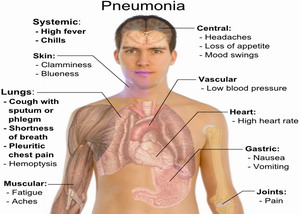 The symptoms of pneumonia include:
 Pneumonia can be surmised from listening to the lungs, with the area filled with fluid having decreased breath sounds, where bronchitis has wet, moist sounds. But the only way to truly diagonse is with x-ray, showing an opaque area where the fluid has accumulated.


 Posts
Posts


